How do NGOs Support Women to Pursue Their Education in a Vast Field?
In every human being’s life, education is one of the fundamental necessities that shapes the future of economies worldwide. Furthermore, the academic well-being of individuals, particularly girls and children, contributes to the societal enhancement of the more disadvantaged sections of society. Likewise, worldwide, there are over 130 million girls who are still unable to attend school. In most third-world nations, girl children are not allowed to get a basic education. Additionally, the reasons could be many, such as child marriage, religious extremism, poverty, and unawareness that does not permit girls’ education, and other fundamental rights.
Nevertheless, several popular NGOs in India and other humanitarian agencies are working rigorously towards this goal of helping girls with better education. NGOs, such as PARD INDIA, work together with the government, non-profit organizations, and non-governmental organizations. Moreover, there are numerous difficulties and challenges associated with girls’ education in India. In India, there are over 200 million illiterate women, which is one of the highest in the world, despite the constitution delivering free and mandatory education to all. Likewise, the metropolitan female literacy rate is 64%, whereas the rural female literacy rate is half that of the urban, which is 32%. Additionally, in this blog, we will discuss the challenges faced by women and how PARD INDIA, as the best NGO in India, is helping to deliver fundamental education to girl children.
Challenges Women Face in India
In this section, we will discuss some fundamental challenges that women face, which become crucial barriers to their basic education.
1. Poverty
Poverty is the most significant obstacle to the education of girls. Numerous extra expenses are involved, which encourage demotivation of the girl child’s families. Bus fare, textbooks, and so on, these expenses put the total sum together, because of which poor families discourage their girl child from being educated. Also, poverty is the leading cause of illiteracy, according to the World Bank. In addition to the exempted fee, there are other facilities like books, uniforms, and transport facilities that are also essential to make education accessible to all.
2. Child Marriage
It is one of the serious issues in most countries. Therefore, according to UNICEF, approximately 700 million girls in the entire world get married under the age of 18. Furthermore, 4 out of every 10 girls in Sub-Saharan Africa and Southeast Asia are early-married and deprived of education. Child marriage also gives birth to numerous other problems like early pregnancy, domestic violence, and others.
3. Home Chores
In a study, it has been estimated that worldwide, approximately 40 % of the time is consumed by girls in doing unpaid household chores such as cooking, cleaning, and more. Girls aged between 14 and 20 years old in developing nations have an increased workload of domestic chores compared to boys. Spending more time on domestic chores ultimately means less time for school.
4. High Drop-Out Rates
According to the study, at the primary level, a higher number of boys drop out of school in the primary level (class 1-5), at the upper primary level (class 6-8), the girls’ drop-out rate is more than that of boys and at the upper primary level (class 9-10) boys drop-out rate is more. According to reports from 2012 to 2020, around 15% of girls drop out of school at the national level.
How Do the Best NGOs Enhance Girls’ Education?
There are numerous NGOs worldwide that operate for the cause of girls’ education, and they have direct contact with those in need. Furthermore, there are various ways in which the best NGO for education in India can help enhance the education of girls worldwide.
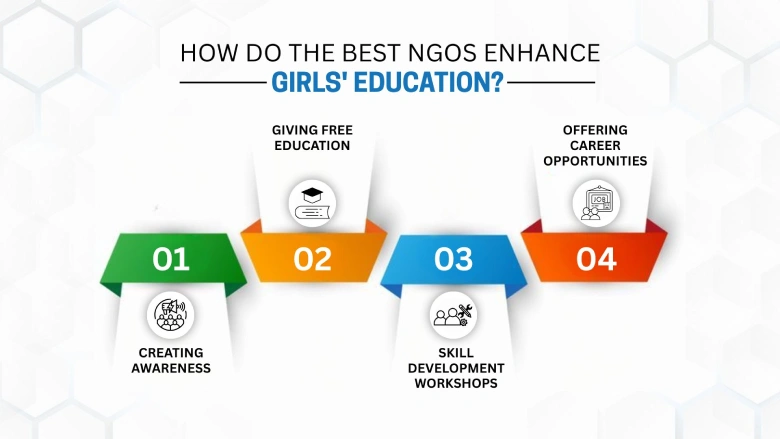
1. Creating Awareness
NGOs also organize activities that can help promote girls’ education and raise awareness about the significance of girls’ education, highlighting how it can improve their family situation and increase their economic and social power. Moreover, the majority of the weaker sections of society are unaware of the positive effects that education can have on society. Therefore, educating girls about this lack of awareness can be challenging for them. Consequently, it is the responsibility of women empowerment NPO and other organizations to create awareness about girls’ education and empowerment. It should be done in specific areas where literacy among girls and women is extremely low.
2. Giving Free Education
NGOs collect donations from other organizations, which can be used to provide free education to girls. Free education comprises numerous different things. Thus, it includes establishing new schools in areas accessible to children and giving books, food, and infrastructure such as clean water, power supply, and furniture in schools. Additionally, they may offer scholarships to deserving students and give them rewards for their performance.
3. Skill Development Workshops
In addition to elementary education, several skill development workshops must be conducted by popular NGOs in India. These workshops will enhance their network by taking different skill development courses, and they will become financially independent. The skills must be in a manner that they can offer them career opportunities and will allow them to run their business and make them economically powerful.
4. Offering Career Opportunities
Free education for girls is not merely restricted to basic education. Still, it should also open doors to future opportunities, career guidance, and counseling, allowing them to apply their education in the sphere where they have proficiency. Unemployment opportunities may be disappointing and suggest that education does not guarantee employment. Therefore, to make education more beneficial, it is essential to provide access to career and employment opportunities. We at PARD INDIA, the best NGO for education in India, offer interview training, as well as job training, which should also be incorporated into this initiative. The intention is to empower individuals and help them become independent.
5. Education for Women of All Ages
Basic and quality education is the fundamental right of women, regardless of their ages. There were many women in the world who never had any chance to attend school and acquire a proper education. By the same token, people of all ages should be motivated to acquire appropriate education. Furthermore, they should be trained in different skills, which can make them self-reliant and economically strong.
It’s Time to Conclude Here!
When women are empowered in their own lives and careers, the positive ripple effect benefits their own lives and jobs as well as the entire families and communities they are part of. Children are raised in more stable and nurturing homes. Economies become stronger, and society is closer to achieving true gender equality.
At PARD INDIA, the top 10 NGO in India, we consider that empowering a woman improves not only her own life, but also the lives of her children and her community. We want to bring change by beginning with providing a secure, inclusive space for the children and families, and particularly those from the marginalised communities.