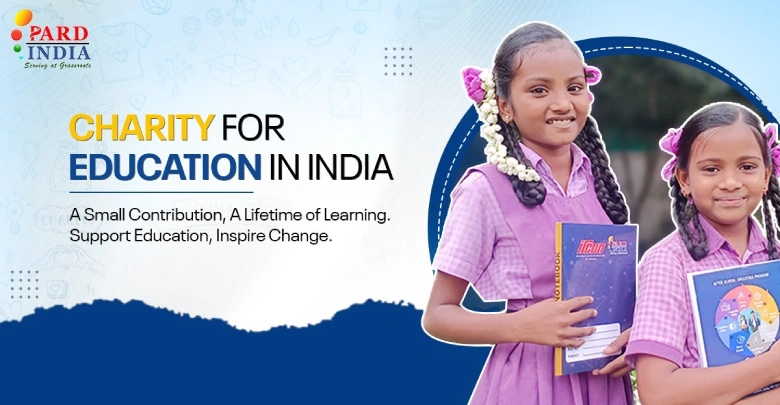
How are PARD INDIA’s Mentorship and Parent Counseling Transforming Education?
Many NGOs have established education pipelines within rural areas due to their programs and charity for education in India. It has been quite an eventful journey, molding the destiny of millions of people, their families, and even in some cases, the entire community. Communities that had given up on life were able to enroll their children in schools, and India managed to produce a lot of leaders out of them. But while everyone else has succeeded with the help of stationery materials, education, and all-round support, first-generation students are finding it tough.
As a leading charity for education in India, PARD INDIA understands and recognizes the needs of children. It states that just handing them notebooks and textbooks isn’t enough to break the cycle of poverty. It sheds light on hidden problems that first-generation learners of families living in rural areas face. Working on it and actively making the support system around them is vital. This guide covers exactly that, from defining the problem to highlighting the solution that PARD INDIA is bringing to the community.
Why is Schooling Tougher for First-Generation Community Learners?
When we imagine the problems facing rural students, the first images that come to mind include falling schools. This may be due to a lack of books or the presence of too much poverty. However, for children who fall under this category but are the first generation in their families to receive an education. There are invisible barriers they face that charity for education in India needs to solve.
The reality is that such children do not grow up in a family environment that understands the importance of school. For a child born into families where parents are paid per day to work and go to class in the morning. Their perception of leaving at night may mean they return to homes where the idea of doing homework is unfamiliar. Earning food takes priority over graduating one day.
The reasons why equal opportunities in school will never be enough unless the entire educational process is equal for students. In similar situations, this can be understood by comparing them to other students:
| Education Hurdle | Supported Learner | First-Generation Rural Learner |
|---|---|---|
| Homework & Support | Parents help with assignments and clarify daily doubts. |
No at-home support. Illiterate parents cannot help. Consequence: Unresolved academic struggles cause the child to fall permanently behind. |
| Financial Pressure | Education is the family’s undisputed top priority. |
Survival over schooling. Consequence: The immediate need for daily wages or farm labor outweighs schooling, pushing children to drop out. |
| Psychological Burden | Faces normal academic pressures like grades and tests. |
Severe isolation. Consequence: Minor academic stumbles feel like massive failures, leading to extreme frustration and a cultural disconnect. |
| Role Models | Surrounded by educated family members who guide their path. |
Lack of role models. Consequence: Without seeing the real-world value of a degree, it is difficult to visualize a future outside poverty. |
| The Dropout Risk | A family safety net ensures struggling children are tutored. |
High dropout risk. Consequence: With no one advocating for their education, slipping grades seamlessly transition into abandoning school entirely. |
Role of PARD INDIA in Bridging the Generational Divide
To support children on a continuous learning path, it’s important to adopt a holistic approach that addresses both the child and the community. Here’s how PARD INDIA has started contributing, and any other NGO can also join in to start their own. Or you, as an individual, can understand our approach and contribute through donation or volunteering.
1. Mentorship Outside the Classroom
First-generation learners cannot seek any assistance from their parents regarding home assignments; hence, they run high chances of falling behind in class. PARD INDIA steps in by giving continuous guidance and mentorship to such learners. The organization takes on the role of “educated guardians,” ensuring that a hard math assignment does not lead to dropping out of school.
2. Relieving Financial Strain
Financial strain poses one of the most pressing issues for rural families in India. Any form of financial constraint always leads to educational sacrifices, with learning institutions being the most affected parties. PARD INDIA addresses this challenge head-on by distributing a range of learning materials, including notebooks, school uniforms, and bicycles.
3. Parental Counseling and Community Building
You cannot teach a first-generation learner without addressing their parents. The PARD INDIA organization takes on the task of counseling uneducated parents regarding child rights and explaining the economic advantages that come along with obtaining a degree. PARD INDIA helps transform skeptical parents into proactive participants in their child’s educational process by altering their focus from earning money on a daily basis.
4. Bridging the Digital Literacy Gap
With the current technological advancements, it is impossible to get around knowing computers nowadays. Unfortunately, first-generation learners who reside in rural villages do not have access to technology, which means they lack digital literacy skills that are required for competing in an increasingly tech-savvy world. PARD INDIA seeks to impart computer education in such villages.
5. Preventive Healthcare for Attendance
Health and education are two sides of the same coin. If a child is suffering from preventable diseases, how can he/she concentrate on education? Students who belong to the first generation are unable to attend school for several weeks as a result of a lack of healthcare facilities in their rural areas.
Final Words!
Being first in the family to seek education instead of the field is a brave but difficult decision that burdens the children. A charity for education in India needs to support them through this journey of overcoming hidden psychological burdens. It will also ensure their mission of educating rural children is fulfilled and continues at the pace set with years of hard work. If first-generation learners get support, you aren’t just changing one life. But it’s the moment that rewrites the history of an entire family lineage.
PARD INDIA, being a global organization, is contributing towards this change in several ways. That includes providing mentorship to children, easing the financial burden, and offering parental counseling and community building for support. We, as a charity for education in India, have started a movement to ensure the learning continues. Participate with us through a donation, volunteering, or any way you can.
FAQs
A first-generation learner is a child who is first in their family to attend formal schooling. Their parents typically lack basic literacy, which makes at-home academic support and guidance nearly impossible. This makes it hard for them to continue studying, as their priority shifts to day labor to bring food home.
These students face immense pressure to abandon their studies for daily labor wages, as this is what they have seen so far. For people juggling food for 2 times, always prioritize one more helping hand in the field to make enough money for food. Without parental academic guidance, early failures often lead to frustration, causing them to drop out to support their family financially.
PARD INDIA makes sure of absolute transparency by means of regular auditing, project progress reports, and updates from the donors themselves. We make sure that whatever is donated as charity for education in India reaches the right place.
Absolutely! PARD INDIA works with corporate organizations to implement various CSR activities that involve rural education, healthcare, and other environmental initiatives as per the needs of your organization.
Apart from being a charity for education in India, PARD INDIA also conducts health camps, environmental campaigns such as Vana Mahotsavam, and children’s rights initiatives.