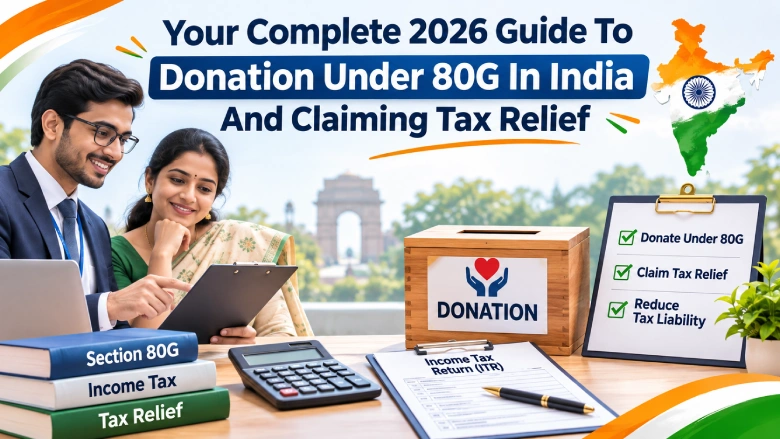
Your Complete 2026 Guide To Donation Under 80G In India And Claiming Tax Relief
There is a certain increase in donation under 80G in India to support a good cause and community development. But most taxpayers don’t know this money can come back to you as well in the form of tax savings. Under Section 80 G, donations give you leverage to decrease your taxable income by 0% to 100% if it’s donated to registered NGOs. Meaning you can save half to all the money you donate to support NGOs working towards uplifting marginalized community groups.
Meaning you can support child education, feed the hungry, or support women through donations under 80G in India and get rewards. You can get rewards from the government for your generosity in the form of a lower tax bill, but not every NGO qualifies for it. Therefore, in this comprehensive guide, we will clear every doubt about how to claim these deductions and fill the ITR for an 80G claim.
Understanding Section 80G And How Tax Relief Operates
Section 80G is a tax provision under the Income Tax Act, 1961, provided by the government to encourage people towards charitable giving. With benefits like tax deductions for donors, giving relief of 50% to sometimes 100% deductions. Meaning you become eligible to deduct a percentage of the donation from your gross total income when filing taxes. It benefits both the people who are donors and NGOs, supporting marginalised communities to get the donations to carry out their programs.
Donation under 80G in India are categorized into two different categories, so let’s see what they are:
- 80G (50%): Under this category, donors can deduct 50% of their donation amount from taxable income while filing ITR at the end of the year. Most NGOs that work in child education or food relief hold the 80G (50%) certification.
- 80G (100%): Under this, your entire donation amount is deductible, and you get the benefit of a full refund. There are very few government-affiliated funds, including the Prime Minister’s National Relief Fund, that are the ones with 80G (100%).
One important consideration to keep in mind for donors is that this 80G (50%) donation has a qualifying limit. Any donation without fulfilling the limit doesn’t get exemption, and even the qualified limit cannot get a deduction above 10% of your gross total income. Private NGOs running around in areas don’t have the qualifying limit, at least most of them, which is a better deal for donors.
Key Distinctions Between Section 80G And Section 12A Approvals
Many contributors frequently confuse Section 12A and donation under 80G in India, yet these legal provisions fulfill entirely distinct regulatory functions. Simply stated, Section 12A shields charitable organizations from paying tax on operational surplus funds, while Section 80G rewards philanthropic donors with personal income tax deductions. The comparative matrix below outlines both statutory certificates, helping you evaluate legitimate charitable entities before contributing funds.
| Feature | Section 12A Certification | Section 80G Certification |
|---|---|---|
| Beneficiary | Exempts the NGO from paying tax on surplus funds | Benefits donors by lowering their taxable income |
| Tax Relief | Offers zero financial rebate to contributing taxpayers | Provides 50% or 100% deduction on donations |
| Documentation | Requires NGO audit reports and trust deed filings | Demands stamped donation receipts and Form 10BE |
| Legal Purpose | Serves as mandatory proof of authentic NGO status | Secondary approval designed to encourage public giving |
| Renewal Rule | Renewed periodically to retain institutional tax-exempt status | Verified regularly to maintain donor deduction eligibility |
How To Confirm An NGO’s 80G Approval Status On The Official Portal
It may surprise you to know that there are fake 80 G certificates, so donation under 80G in India need verification. This involves NGOs that photocopy expired certificates or create registration numbers from scratch. However, here are the steps involved in verifying the certificate within two minutes without much trouble.
Step 1: Visit the Website for Income Tax e-Filing
Open up the website www.incometax.gov.in where there will be an option ‘Search for 80G registered entities’ in the Quick Links section.
Step 2: Provide Name or PAN Number
Enter the name registered with the Income Tax Department and/or the PAN number associated with the NGO. In the case of IQRA Welfare Trust, enter the name IQRA Welfare Trust.
Step 3: Verify ‘Active’ and Approval Period
The status of the NGO must show Active along with an approval period covering the present financial year. Otherwise, donations made are non-deductible.
Step 4: Compare Donation Receipt with Registration
Ensure that the receipt carries the same registration number as that displayed on the website for tax purposes. This is crucial.
Step-By-Step Process To Claim Your Charitable Deduction In Your ITR
Availing deductions under Section 80G can be relatively easy when one has all the relevant paperwork that PARD INDIA provides. Below is a detailed explanation of what must be done before starting the process:
- Collect the official receipt issued by the NGO. The receipt should contain information like name, address, PAN card, 80G registration number, amount donated, date, and method of transaction.
- Keep evidence of the donation made through the UPI screenshot, banking confirmation, cheque leaf copy, etc. Note that cash donations above Rs 2000 cannot avail any benefits under section 80G.
Now let’s discuss the step-by-step approach towards claiming 80G deductions:
Visit the income tax website, log in to your account, and fill out the appropriate ITR forms (ITR-1 for salaried individuals and ITR-2/3 for other categories). Next, click on the Chapter VI-A Donations to Charitable Institutions present under the deductions column, and go to Schedule 80G. Provide all necessary information, including NGO name, PAN, 80G registration no., total donation amount, and deduction rate.
Concluding Note!
Planning a donation under 80G in India offers a unique dual benefit where, on one hand. You get the opportunity to help out poor and disadvantaged sections of society while reducing your yearly income tax burden. Through donation in the hands of trusted NGOs like PARD INDIA, you will be able to channel your money in different areas. This includes child development projects, rural education, and health services. On the other hand, your donations will allow you to get proper documentation for deduction of tax through ITRs in the form of receipt and Form 10BE.
Frequently Asked Questions
This depends on the tax slab that you come under. If you fall under the 30% tax slab and make a donation of ₹10,000 to any NGO that is 50% eligible under Section 80G, then you save ₹1,500 on taxes.
Just go to the Income Tax online e-filing website and find out about the NGOs who are registered on the portal using the PAN of the NGO or its name, and confirm that the status of 80G is current.
Yes, digital donations made through UPI, net banking, or card transactions can be claimed for 100% under Section 80G of the Income Tax Act.
Yes, PARD INDIA holds valid Section 80G and 12A registrations from the Income Tax Department. Donors contributing to PARD INDIA are eligible to claim a 50% tax deduction under prevailing laws.