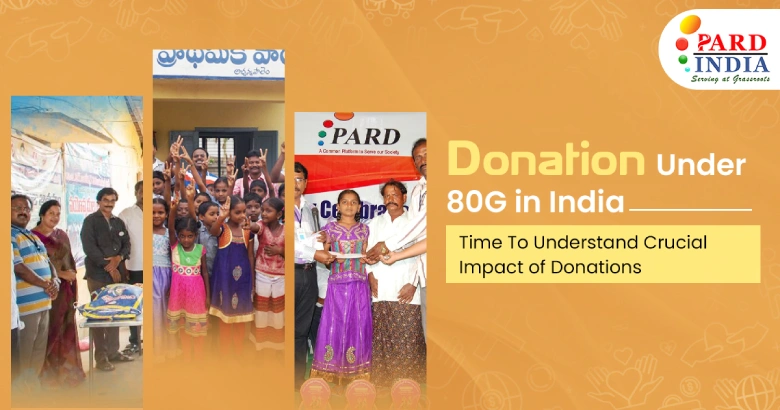
Donation Under 80G in India | Time To Understand Crucial Impact of Donations
In India, charity and social responsibility run deep within the nation’s culture. Through small donations or extraordinary funding, giving helps address core societal issues such as poverty, education, and health. The Indian government values this contribution and offers tax relief under Section 80G of the Income Tax Act, thereby enticing more individuals and organizations to donate to society.
Moreover, understanding how donations under 80G work and their impact on Non-Governmental Organizations (NGOs) will help donors make informed choices that result in long-term change. However, in this comprehensive blog, we will discuss the dynamics of donation under 80G in India, their benefits, the change-making aspect of donations in the NGO sector, and why choosing a credible organization like PARD INDIA will yield maximum social and tax returns.
An Overview of Section 80G of the Income Tax Act
A donation under 80G in India allows taxpayers to claim deductions for contributions made to eligible charitable organizations. However, this initiative encourages individuals and corporations to contribute to public welfare without the fear of heavy tax burdens.
1. Eligibility for 80G Deduction
Donations should be made only to a Section 80G-registered non-governmental organization. The organization should have a valid 80G certificate from the Income Tax Department to ensure accountability and transparency. The best NGO in India should also ensure that it does not engage in profit-making activities, promote religion, or support political parties. Renewing the 80G registration is also mandatory for continued eligibility.
2. Percentage of Deduction
Depending on the NGO’s category, donors can claim 50% or 100% deduction of the donated amount. The actual limit depends on whether the organization falls under the “with limit” or “without limit” category. For example, contributions to funds like the Prime Minister’s Relief Fund qualify for a 100% deduction, while donations to the top 10 NGO in India are eligible for a 50% deduction.
3. Mode of Donation
Donations can be made through cheque, draft, or digital payment methods such as UPI, net banking, or credit/debit cards. Also, it ensures transparency and easy transaction tracking. Cash donations are allowed only up to ₹2,000 for claiming a deduction under 80G. Hence, donors are encouraged to make digital contributions, which not only simplifies record-keeping but also aligns with India’s push toward a cashless economy.
4. Significance of Donation Receipts
When making a donation under 80G in India, donors must obtain a receipt that includes the organization’s name, PAN, and 80G registration number. It serves as proof during income tax filing and ensures the legitimacy of tax benefits. The receipt should also include the date, payment method, and donation amount. For larger contributions, a stamped acknowledgment letter or donation certificate adds another layer of authenticity and helps during tax assessments.
5. Who Can Claim 80G Deductions?
Both individual taxpayers and companies can avail deductions under Section 80G. Salaried employees, professionals, HUFs, and firms can all claim benefits by submitting valid proof during filing. Therefore, companies often include these donations as part of their CSR (Corporate Social Responsibility) initiatives, aligning financial incentives with social goals. Likewise, this collective participation promotes a nationwide culture of empathy and shared growth.
What is the Crucial Impact of Donations on NGOs and Society?
Donations are the backbone of the best NGO in India. It empowers organizations to expand their reach, develop programs, and sustain social welfare, education, and healthcare efforts.
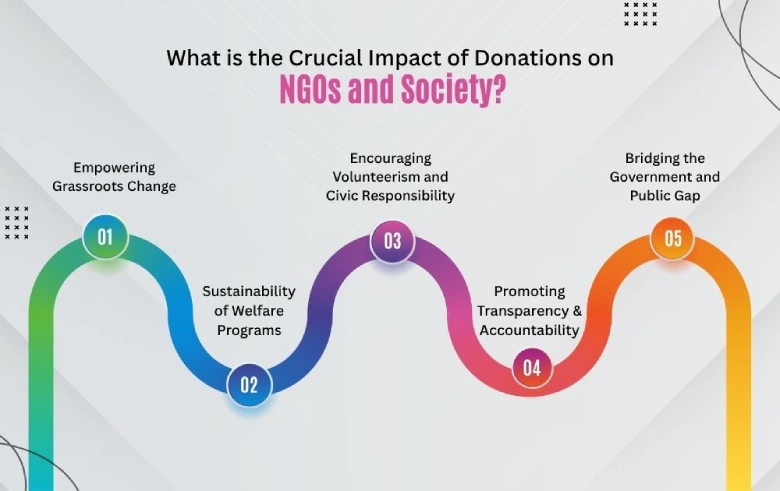
1. Empowering Grassroots Change
NGOs often work directly with underprivileged communities that lack access to government resources. Donations help fund their initiatives, empowering locals with education, healthcare, and employment opportunities that transform entire villages and urban slums. A well-supported NGO can establish schools, vocational training centers, and health camps, creating real, measurable progress where it matters most.
2. Sustainability of Welfare Programs
Without continuous financial support, many impactful projects may not stand. Regular donations enable the top 10 NGO in India to plan long-term projects with measurable outcomes. For instance, health programs or education drives need consistent funding to stay effective. Moreover, recurring contributions allow organizations to retain skilled staff, maintain facilities, and monitor outcomes, ensuring sustained social transformation.
3. Encouraging Volunteerism and Civic Responsibility
Donations often inspire citizens to get involved beyond financial support. NGOs use funds to organize awareness campaigns, environmental drives, and youth training programs. Moreover, this encourages individuals to volunteer their time and skills, cultivating civic responsibility and a culture of compassion. Consequently, the more people participate, the stronger the social fabric becomes.
4. Promoting Transparency and Accountability
Popular NGOs in India, registered under 80G, are legally required to maintain transparent financial statements and undergo periodic audits. This transparency builds donor confidence and promotes responsible use of funds. Most reputed NGOs also publish annual reports and impact stories, showcasing exactly how donations create change. Such openness strengthens public faith and encourages sustained giving.
5. Bridging the Government and Public Gap
Many NGOs act as intermediaries between citizens and government welfare schemes. Donations enable them to amplify government programs, ensure last-mile delivery, and adapt initiatives for specific local challenges. For example, an NGO can help implement skill development programs in rural areas where government infrastructure is limited, thereby effectively connecting the public to opportunities.
What are the Imperative Benefits of Donating Under Section 80G?
Donations drive societal transformation and yield significant tax benefits for donors. Section 80G provides a valuable way to give back to society while minimizing one’s tax burden.
1. Dual Advantage of Giving
Giving under 80G benefits social causes while minimizing taxable income. It prompts individuals to combine compassion with financial planning. Nonetheless, this two-way benefit has influenced both individuals and corporations to view charity as part of their overall tax and wealth-planning strategies, rather than as an occasional act.
2. Promotes Systematic Philanthropy
With systematic deductions, donors can schedule regular donations, providing popular NGOs in India with a steady source of funds to carry out projects. Organized charity results in stable project implementation, particularly in areas such as education, women’s welfare, and health. Such regular funding enables NGOs to prepare budgets effectively and attain reliable returns for long-term community development.
3. Increases Corporate Social Responsibility (CSR)
For companies, contributions under 80G align with CSR responsibilities under the Companies Act. The contributions enhance a company’s public image, boost employee morale, and reflect a commitment to ethical business practices. Moreover, organizations also involve employees in CSR volunteering, integrating workforce involvement and social advancement.
What are the Fundamental Steps to Claim 80G Tax Deductions?
Understanding the claim process ensures donors receive full benefits while maintaining compliance with tax regulations.
Step-1: Verify NGO’s 80G Registration
Step-2: Make Donations Through Traceable Modes
Step-3: Collect and Preserve Donation Receipts
Step-4: Include Details in Income Tax Return
Common Donation Categories and Applicable Deductions Under Section 80G
| Type of Institution/Donation | Percentage of Deduction Allowed | Maximum Limit of Deduction | Examples |
| Prime Minister’s National Relief Fund | 100% | Without limit | PMNRF, National Defense Fund |
| Approved charitable institutions | 50% | Up to 10% of Gross Total Income | Registered NGOs, Social Welfare Trusts |
| National Foundation for Communal Harmony | 100% | Without limit | Government-notified foundations |
| Government or local authority for charitable purposes | 50% | Up to 10% of Gross Total Income | State-run welfare schemes |
| Swachh Bharat Kosh / Clean Ganga Fund | 100% | Without limit | National cleanliness initiatives |
Why Choose PARD INDIA for Donation?
PARD INDIA (People’s Action for Rural Development) is a model of trust, transparency, and outcome-based social work. PARD INDIA, the best NGO to donate food in India, assures that every rupee donation reaches the grassroots where it is most needed. It is active in facilitating education for disadvantaged children, women empowerment, access to healthcare, and livelihood programs with sustainability.
Our open-book reporting platform, regular project audits, and measurable impact assessments place PARD INDIA among the most reliable platforms for high-impact giving. With every donation, you will receive tax relief and become an investor in India’s journey toward inclusive growth and equality.
It’s Time to Wrap Things Up!
Donation under Section 80G is not just a tax-saving decision. Thus, it’s a moral and social responsibility to create a better India. These donations fuel the efforts of NGOs that tirelessly strive to empower individuals, bring education, and improve living conditions. Furthermore, with tax-deductibility, giving is rewarding and innovative. As a group and as individuals, our giving can build bridges of hope and potential.
Furthermore, if you are looking for the best NGO in India to support credible organizations, PARD INDIA ensures your donation is substantial, open, and long-lasting. With collective, conscious giving and engaged citizenship, we can create the platform for a gentler, more inclusive India. So, what are you waiting for? It’s time to donate and support the deprived community with reliable hands.
Donate, Spread A Word, or Volunteer With Us!