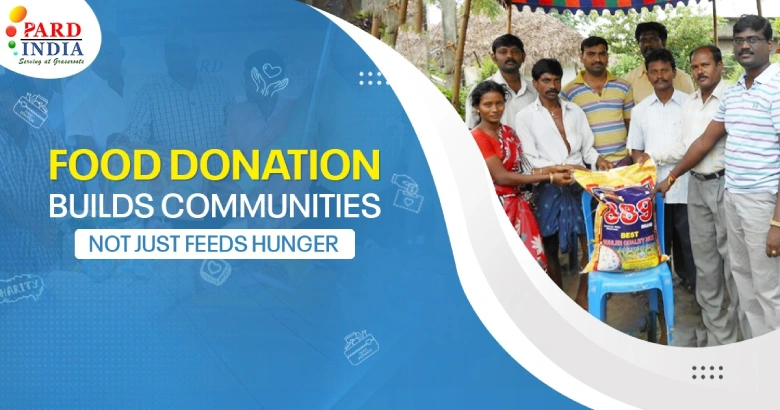
Ways Food Donation Drives Community Changes And Not Just Provides Hunger Relief
One of the major misconceptions people have about food NGOs is that they only fill empty stomachs. While it’s true that we search for NGO to donate food in India, we expect to donate food to fill empty stomachs. However, NGOs approach these food donations to address various societal needs and empower communities so they can become self-reliant and stronger. While the nutritious food offers better ways to sustain life, feed families and children, and support the destitute elderly.
It serves each age group in more than one way, such as by filling children’s stomachs while keeping them in the classroom. Furthermore, encouraging families to send their children to school thereby reduces child labor. In addition to providing employment to tiffin services, reducing food wastage and builds sustainable communities. The approach to food donation in a modern way with an innovative vision is more than emergency relief and short-term dependency.
An NGO to donate food in India transforms lives by providing meals and building collaborative partnerships. Let’s explore how the NGO transforms hunger relief programs into community-led change. This guide covers the multi-dimensional impact on education, the economy, and health while contributing to environmental sustainability through food donations.
Improvements Made in Communities Through Food Donation
Communities have multiple impacts through food donations made by NGOs. It has addressed many concerns while feeding the hungry and providing food to families who can’t afford it. NGO to donate food in India have unlocked unexpected economic opportunities that ripple through entire communities.
1. Increases Employment in the Economy
Food donation programs in India have created equal employment opportunities, then they have supported people through food donation. Their approach to food support creates a ripple effect and creates opportunities through skills development, employment generation, entrepreneurship support, and market linkages. Over time, this program has created 500+ employment opportunities annually because of people starting tiffin and catering services.
2. Increases School Attendance While Nourishing Young Minds
Hunger creates a situation that forces children to do child labor to feed their families instead of going to school. However, the NGO to donate food in India have found a way to fight these obstacles, and the solution relies on mid-day meal programs. Just by sticking to and implementing it, school attendance has increased by 35-40%, as this food distribution improved children’s concentration and academic performance. That reduces dropout rates among families and increases the reach of nutrition in families.
3. Spread Awareness While Targeting Health
Food programs help address many healthcare issues, as the mid-day meal provided by NGOs is nutritionally valuable. This further helps in reducing malnutrition rates and brings them to 30-35%. Alongside mid-day meal distribution, health care camps are run to teach and raise awareness about the importance of nutrition. While the NGOs don’t lack, they provide special care for pregnant women and the elderly, which benefits thousands of families and individuals.
4. Expanded Social Connection and Support
Socially, the food distribution has brought diverse groups together to work and volunteer. The network creates solidarity and has over 1500 volunteers monthly to help. Additionally, the former beneficiaries support this by becoming leaders and helping bring about greater change in other families.
While NGO to donate food in India also impact environmental sustainability by saving 600+ tons of food waste annually. This wasted food gets utilized in making organic fertilizers that support urban farming and promote the growth of community gardens.
5. Providing Food Security and Fostering Community
The strategic and structured food distribution programs run by top NGOs help achieve 25-30% of beneficiaries’ food security and independence within 3-4 years. Later, these beneficiaries themselves become volunteers and leaders to help. The transformation timeline follows:
- Year 1: In it, they get emergency relief, and the NGO builds trust.
- Year 2: The NGO starts skills training to empower the community and families.
- Year 3: After dedicated skills building, employment help is provided, and they start earning, building income stability
- Year 4: With continuous income, they get independence and support the community.
Benefits of Food Donations Drive With Real-World Impact Matrix
Let’s look at the dashboard offered by the NGO to donate food in India. It represents their comprehensive impact beyond the meals served to local communities.
| Areas Supported | Metric | Yearly Results | What It Represents |
|---|---|---|---|
| Direct Relief | Meals provided | More than 5 M meals | People have been fed with food |
| Fulfilled Lives | Beneficaries | > 50,000 individuals | Homes with food security |
| Economic Development |
Jobs created
|
> 500 jobs annually | Independent financially |
| Education | Attendance at schools | Increased by 40% | Students stay in class |
| Health | Malnutrition reduced | By 35% | Healthy communities |
| Skills Education | Trained individuals | > 2,000 yearly | Better employment |
| Entrepreneurship | Created | More than 100 businesses | Self-sufficient business ventures |
| Environment | Waste food saved | >600 tons | Prevent waste from going to landfills |
| Volunteers | Active participants | > 1,500 per month | Community participation |
| Sustainability | Graduated Families | 30% of beneficiaries | Long-term transformation |
With every donated meal kit, the lives of people and children change, while continuous support creates a lasting impact. This cycle represents how one food can impact lives differently. How it addresses the needs of children, an individual adult, and the community.
- One meal → Child attends school → Better education → Breaking the poverty cycle.
- One training → Job gained → Family stability → Community contribution
- One community kitchen → Social bonds → Local leadership → Sustainable networks
Wrapping It Up!
Food donations are the gateway that helps foster many aspects of people in need’s lives. The NGO to donate food in India takes up the opportunity by filling stomachs and contributing to the empowerment of thousands of people. Addressing hunger opens pathways to education, health, and employment for underserved people. The continuous food support fosters families, prompting them to be self-sufficient. As the cycle continues, these families contribute it back, helping others.
Therefore, by applying this principle, NGO to donates food in India prove that food donations are more than just feeding families. It proves that a change in the community can be planted with the right strategy and continuous support. As explained in this blog, the communities build mutual support, and the cycle continues with just one meal of support. Be a part of this cycle today by donating a meal kit with PARD INDIA.
FAQs
Yes, definitely. Food donations can be part of the larger picture that brings about a revolution in one family. Then the cycle wraps whole communities in it. With consistent support, employment, skill development, and livelihood opportunities can be made, making families self-sufficient.
People with continuous support start businesses, creating employment through the skills they learn. Later on, with stable income and improved conditions, they support other people in need through volunteering, donating, or being community leaders.
Yes, of course. We have a streamlined process for partnering with catering businesses and restaurants to collect food. Our partner can reach out at a scheduled time for pickups. Additionally, we ensure proper handling protocols and documentation related to tax exemption. Connect with us through the details present on the PARD INDIA website and support the meal donation.
Our programs include vocational training, entrepreneurship development, health awareness workshops, educational support for children, women’s leadership programs, and livelihood assistance.