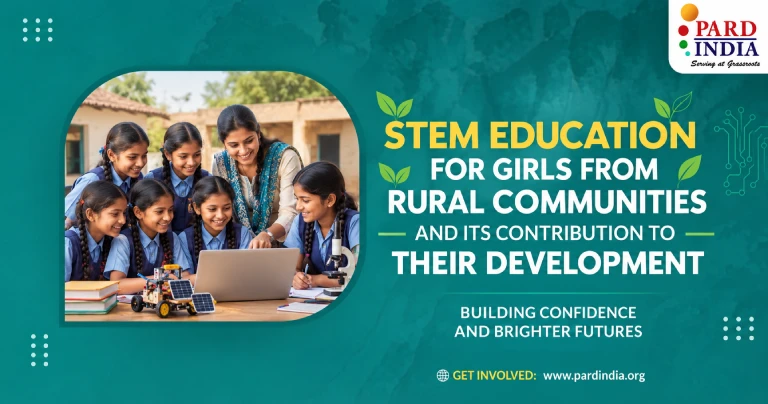
STEM Education for Girls from Rural Communities and Its Contribution to Their Development
The major roadblock in current rural education is that it follows the same old traditional system and outdated curriculum. Kids in rural schools are still focused on cramming lessons and memorizing information without actually learning how to use it to solve real-world problems. This is why NGOs in India, with government support, are promoting STEM education in rural communities. STEM, or Science, Technology, Engineering, and Mathematics education, puts students in the driver’s seat and demands their attention and consistent involvement. This helps move from memorizing things to actually developing critical skills.
STEM education, especially for girls from rural communities, has multiple benefits. It not only helps them stand on their own feet, but also contributes to the holistic development of rural families. It gives the girl child a way to break the poverty chain and contribute equally to their family’s welfare. Let’s discuss STEM education for girls in more detail through this blog.
What is STEM Education?
Education and its meaning in modern times cannot be limited to qualifications or how much bookish knowledge you have. A well-educated individual today must know how to use and integrate technology and needs to have additional skills such as critical/logical thinking, problem-solving, and adaptability. Shying away from technology or these other practical skills might become a serious problem for career growth.
Now, the urban kids have already switched to the modernized education system, but rural kids, specifically the girls, have yet to adopt it. The major challenges in this adoption include:
- Less participation of girls in higher education
- Financial constraints of rural families, making it impossible for girls to attend school
- Inadequate educational facilities in rural communities
- Lack of awareness among rural families
STEM Education is the modern way of teaching and preparing young minds for the uncertain future. And the participation of girls in this movement is extremely necessary and is bound to have a positive impact.
Benefits of Participating in STEM Education for the Girl Child
STEM Education for the girl child is more of a necessity than an option. It benefits them in multiple ways, which translates to community-wide welfare. You can find more information on the benefits in the points below:
1. Building Confidence from a Young Age
STEM education for girls is crucial for building practical skills and knowledge from a very young age. Once they start to learn practical skills, it helps them build confidence in their skills and abilities. Girls from rural communities, with the right education model, can easily tackle complex tasks and actively support their families.
2. Preparing Girls for Modern Jobs
In most of the modern jobs, technological knowledge is a key requirement. Therefore, hands-on experience with modern technological tools and software applications prepares them for advanced job roles, ensuring a financially secure future for them.
3. Bridging the Gender Gap in Education
The education of a girl child in rural communities is often neglected, citing social norms and pseudo-cultural values. This has created a huge gap in modern education. STEM education, along with equal opportunities for all genders, can bridge this gap to ensure a brighter future for girls from underprivileged communities.
4. Spreading Awareness in Rural Families
NGOs and government initiatives for STEM Education include awareness campaigns. Through these campaigns, rural families are taught about the importance of girls’ education. This inspires rural families to prioritize girls’ education and help break the social norms.
5. Improved Participation of Girls in Social Welfare
An educated girl child can be a future doctor, engineer, social worker, or a teacher. The possibilities are endless because every girl has the potential to give a valuable contribution to social welfare. “Society must unite to promote STEM education for the girl child.
Statistics Related to Girl Child Education
The statistical data show both concerns and a positive side for girl child education. While the urban population is making great progress, rural areas still lack the awareness and motivation to promote girl child education.
- Female literacy: India’s female literacy rate among people aged 7 years and above was 74.6% in 2023–24, according to the Periodic Labour Force Survey (PLFS) of the Ministry of Statistics and Programme Implementation (MoSPI).
- Gender gap in literacy: PLFS 2023–24 reported a national literacy rate of 74.6% for females, compared with 87.2% for males, indicating a 12.6 percentage-point gender gap.
- Girls enrolled in school: UDISE+ 2024–25 recorded approximately 119.3 million girls enrolled from foundational to secondary education in India. Girls accounted for roughly 48.3% of total enrolment at these levels.
- Primary-school dropout among girls: In 2024–25, the national dropout rate for girls at the primary level (Classes 1–5) was 0.0%, according to UDISE+.
- Upper-primary dropout among girls: The dropout rate for girls at the upper-primary level (Classes 6–8) was 2.9% in 2024–25.
- Secondary dropout among girls: At the secondary level (Classes 9–10), the female dropout rate was 9.6% in 2024–25. This is substantially higher than the primary and upper-primary rates.
- Girls’ participation in higher education: According to AISHE 2021–22, the female Gross Enrolment Ratio (GER) in higher education was 28.5%, slightly higher than the male GER of 28.3%.
PARD INDIA – Shaping the Future of Rural Communities
PARD INDIA has been working tirelessly for the welfare and development of rural communities since 2011. We know that the girls from rural communities are truly capable of transforming societies into a better place. Therefore, our READ project and social campaigns put extra emphasis on girls’ education, which has allowed us to positively change many lives.
Our work for the rural communities is not limited to education. As the best NGO in India, PARD INDIA covers nutrition, health, clean water, hygiene, and many other aspects to provide the rural population with a quality life. But we need your support to sustain our welfare work and to reach more and more rural families.
Please visit our donation page and help us with any amount convenient to you. Want to be a part of our journey and bring a change to society? Join our membership campaigns.
STEM Education for Girls, A Crucial Cog for National Development
STEM education can play an important role in helping girls from rural communities develop the knowledge, confidence, and practical skills needed to keep up with modern social development. Introducing students, especially girls, to science, technology, engineering, and mathematics through practical and engaging learning is truly beneficial for society. It has the power to transform education beyond memorization to encourage problem-solving, creativity, and critical thinking. For girls who face barriers to education, access to quality STEM learning can also open pathways to higher education, employment, and greater financial independence.
However, improving access to STEM education requires collective efforts from schools, families, NGOs, communities, and government programs. Providing learning opportunities is only one part of the process. To overcome the challenges, girls also need encouragement, suitable educational facilities, financial support, and an environment where they can continue their studies. Organizations such as PARD INDIA are continuously contributing to this effort by supporting educational initiatives and creating greater awareness about the importance of educating girls in rural communities.
Frequently Asked Questions
STEM education combines Science, Technology, Engineering, and Mathematics with practical and problem-solving-based learning. For rural students, it can help develop critical thinking, digital literacy, creativity, and other skills that are increasingly useful for higher education and modern careers.
Girls in rural communities may face challenges such as financial constraints, limited access to schools, and household responsibilities. In addition, inadequate infrastructure, lack of awareness, and restrictive social attitudes often discourage continued education.
STEM education can help girls develop problem-solving, analytical, digital, and technical skills. It can also encourage them to explore higher education and careers in areas such as engineering, technology, healthcare, research, and other STEM-related fields.
Educating girls can contribute to better economic participation, greater awareness of health and education, improved decision-making, and stronger participation in community life. When girls have access to quality education and opportunities, the benefits can extend beyond the individual to families and communities.
NGOs can support STEM education by providing learning resources, organizing practical learning programs, improving digital access, conducting awareness campaigns, supporting scholarships or educational assistance, and working with schools and communities to encourage girls to continue their education.