Beyond Literacy: How the Best Education NGOs in India Empower Rural Children With 21st-Century Skills
In the quest for the best education NGO in India, one must necessarily move away from the stereotypical approach of memorizing knowledge. Without any practical application. For years, the only task was to make a disadvantaged child literate enough to learn the ABCD and clear state exams. However, while initial literacy remains an important component, much more is required in this modern world. An education system that ends with teaching children to read and write leaves rural youth completely unprepared for the challenges. They have to face the highly competitive and technologically oriented job market.
Educational interventions aimed at helping people should be targeted at empowering them, and not at just memorizing information. This is precisely the reason why one should choose the best NGO for education in India, based on the ability to transform. The grassroots classroom environment completely. In order to provide equality in education, the NGO should aim at giving rural children the very same set of skills. That includes leadership qualities and technical know-how that urban children have.
The Gap Between Basic Literacy and Real-World Success
While many grassroots programs find great joy in a child learning his ABCs, this should not be where the journey ends. Whenever marginalized youth leave their villages to seek better education or job opportunities, they suffer from major setbacks in terms of unseen disadvantages. To which the best education NGO in India are working. Here are some reasons why basic literacy is not sufficient:
1. The Digital Divide From City Children
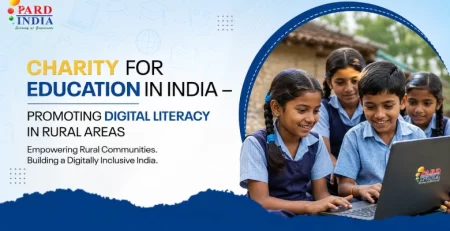
While a child can learn how to read textbooks, if he has not seen a computer before, he cannot survive in the digital age. This is now a basic human right.
2. The Confidence Deficit
Marginalized children are often victims of systemic lack of confidence. Without the soft skills of public speaking and communication, brilliant children find it difficult to speak up for themselves.
3. Rote Learning vs. Critical Thinking
While conventional rural schools may focus on mugging up for exams, real-life skills require the individual to think analytically. PARD INDIA, the best NGO for education in India, is ensuring this gap is filled with volunteer programs and campaigns
4. The Career Exposure Blindspot
Being able to read does not equal being able to navigate the modern job world. Rural children do not have enough exposure to different career choices, networking opportunities, and mentoring, which leaves them stuck in low-paying jobs regardless of how hard they study at school.
Building the Future: Core 21st-Century Skills for Rural Youth
If we want to create lasting change, educational interventions must evolve. The best education NGO in India recognizes that empowering a child means giving them a toolkit for life, not just an exam certificate.
Here is how modern skills translate to real-world empowerment for marginalized children:
| 21st-Century Skill | Traditional Classroom Approach | Empowered, Skill-Based Approach |
|---|---|---|
| Digital Fluency | Reading about computers in a dusty textbook without ever turning on a monitor or touching a keyboard. | Providing hands-on experience with internet research, typing, and basic software tools. |
| Critical Thinking | Memorizing predefined answers from outdated guides solely to pass a standardized state board examination. | Engaging students in active debates, logic puzzles, and real-world community problem-solving exercises. |
| Financial Literacy | Learning only basic arithmetic, like simple addition and subtraction. | Teaching practical financial management, including savings accounts, household budgeting, and avoiding predatory rural loans. |
| Leadership Abilities | Sitting quietly in rows, strictly following instructions without ever questioning authority. | Actively leading peer study groups, participating in local environmental drives, and taking decisive action to solve community challenges. |
Final Thoughts!
The education of rural Indian kids needs to move past the mere process of providing textbooks and basic reading and writing skills. The best NGO for education in India are preparing kids who come from marginalized backgrounds with advanced resources. So they can learn problem-solving abilities, excellent communication skills, and knowledge about computers and technology. Once we move away from the process of rote learning and concentrate on building up these abilities. It will make it possible for the future generation to escape from the restrictions and limitations of society.
PARD INDIA has made it its life goal to advocate for this kind of comprehensive approach toward the empowerment of rural India. We work hard on developing the hidden talents of marginalized kids in villages through our various programs such as V-Kids and V-Bala. You can contribute to closing this large gap in education through us. You can volunteer with us, sponsor the education of kids, or donate to PARD India.
FAQs
The 21st-century skills are digital literacy, critical thinking, problem-solving, and communication. Unlike basic literacy, 21st-century skills prepare rural kids for careers in the modern world by helping them escape poverty and succeed.
Basic literacy enables the kids to learn how to read and write. However, in order to escape generational poverty. They require advanced analytical skills, digital literacy, and confidence to face the changing technological world.
Through our V-Kids and V-Bala special programs, PARD India facilitates holistic early education of disadvantaged children in the remote rural villages by emphasizing cognitive learning, hygiene, and basic learning.
Yes, through our tutoring centers, we help marginalized kids learn and solve their homework and exams with the help of volunteers so that they do not drop out of school.
Absolutely. Our educational camps teach children about public health and sanitation, along with the importance of environmental protection.