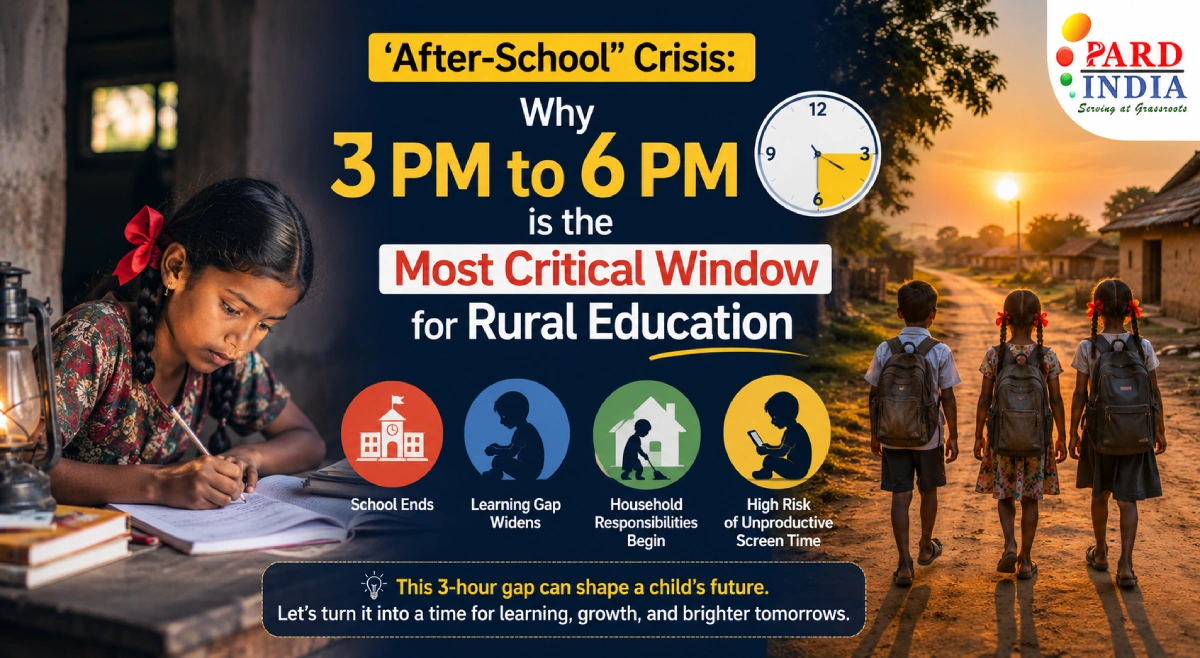
‘After-School’ Crisis: Why 3 PM to 6 PM is the Most Critical Window for Rural Education
Owing to the efforts of the government in this regard, the number of students enrolled in schools in the countryside has never been better. Meanwhile, this has been possible due to enormous effort made by a top NGO in India for education also. But enrolling a marginalized student into school would be nothing more than an illusion of success. Because their education ends the minute the school bell strikes. For countless village students, the actual threat to their future lies at 3 PM in the afternoon.
Education does not occur solely within the walls of classrooms, but also by bridging the crucial after-school gap. It is exactly what converts a failing rural student into a successful graduate. It is identifying such systemic gaps that exist in the education system that make a top NGO in India for education a principle embodied. There are many such organizations out there that are at their core driven by starting such innovations for rural areas.
Tale of Two Realities: Urban vs. Rural After-School Hours
The realities differ for urban and rural children, and when it comes to understanding their reasons behind dropout. It’s essential to put a light on after-school hours. The following table visually contrasts the stark difference in the after-school ecosystems of urban versus rural students.
| After-School Ecosystem | Urban Student Reality | Rural First-Generation Learner Reality |
|---|---|---|
| Academic Support | Urban students transition to paid private tuitions, utilize the internet, and rely on educated parents to actively guide them through their daily homework. | Rural kids are first-generation learners. Their parents, often illiterate laborers, cannot help with academics. They lack private coaching, leaving them helpless with difficult subjects. |
| Study Environment | Urban children return to safe, well-lit private study rooms. They have dedicated desks and face zero pressure to contribute physically to household survival. | Rural students return to cramped environments disrupted by power cuts. They face immediate pressure to complete exhausting household chores or graze cattle instead of studying. |
| Extracurriculars | Urban youth engage in structured extracurriculars like sports, coding, or personality development classes that actively build their confidence and 21st-century skills. | Without structured guidance, rural youth face dangerous idle time. They often fall into bad habits or are pushed into hazardous agricultural child labor to survive. |
How PARD INDIA Reclaims the 3 PM to 6 PM Windows
Breaking this cycle requires a targeted intervention during these vulnerable hours. Here is exactly how PARD INDIA steps in to prevent dropouts and reclaim the afternoon for rural youth:
1. Establishing Localized Study Centers
Learning under conditions of darkness, overcrowding, and noise in such a hut is practically impossible. The learning centers help create a safe space for children where they study in good lighting, without any other distractions.
2. Grassroots Tutoring & Homework Help
When a first-generation learner fails to understand a concept in math class, there is nobody who will explain it to them at home. It causes a lot of frustration and leads to the dropout problem. Dedicated volunteers of PARD INDIA fill the gap by giving the necessary tutorial help in understanding school subjects. That makes the children feel confident about themselves in studies.
3. Value-Based Education (VBE)
We make use of the after-school time through such initiatives as “V-Kids” and “V-Students”. Value-based education is provided to children who learn about important life skills such as personal hygiene, environmental preservation, and moral values. This turns them into responsible community members.
4. Mentorship for First-Generation Learners
Our volunteers become more than just teachers as they become the educated siblings that these kids need. Besides giving psychological support to children, guiding them in their future careers, talking to parents about the necessity of learning, and motivating youth. To think big beyond the borders of the village.
Final Thoughts!
The struggle for rural literacy does not lie in the morning assembly, and the top NGO in India for education knows it. It lies post 3 PM when, without constant and structured assistance, children have left school premises. The poor and marginalized children will inevitably fall through the cracks, thus entering a vicious circle of poverty and child labor.
Ensuring continuous and comprehensive learning processes that will safeguard and care for children even after school hours. It is precisely what makes us known as one of the Top NGOs in India for education. Yet, running such essential programs demands joint efforts, and PARD INDIA also needs it. We call upon all corporate CSR teams, city-based professionals, and philanthropists to sponsor a village study center or give their time.
Frequently Asked Questions
In the absence of proper after-school intervention programs, rural children tend to become either child laborers or simply loiter around. This is an important phase that helps prevent children from lagging behind and getting into danger.
First-generation rural students do not have any academic knowledge from their parents available at home. Since they do not get any supplementary education to clear doubts from classroom teaching, they lose hope, fail in examinations, and ultimately become dropouts.
Definitely. Our volunteers make sure that the academic progress of all enrolled children is monitored regularly in terms of attendance, school performance, and overall personality development.
Of course. The CSR team from corporate houses or philanthropic individuals can provide funds for building a local ‘V-Kids’ or ‘V-Students’ center. It will include tutoring costs, study materials, and infrastructure facilities for the entire village.
Yes, along with expert tutoring, we provide educational kits. These include notebooks, stationery, school bags, and digital learning tools, ensuring marginalized students have everything required to succeed in their daily studies.