Why an NGO for Rural Health in India Must Look Beyond the Clinic?
The conventional process of enhancing the village health sector has been very easy: construct a clinic, employ a physician, and provide medications. But despite having done all this for the longest period of time, NGO for rural health in India have not seen any sustainable improvement as far as the situation is concerned. Why? Dealing with a disease after its appearance can hardly be termed as an effective and practical method because it doesn’t consider the ground realities. The traditional system functions in a vacuum and fails to take into account the fact that the health of the patient depends largely on his food, land, and source of livelihood.
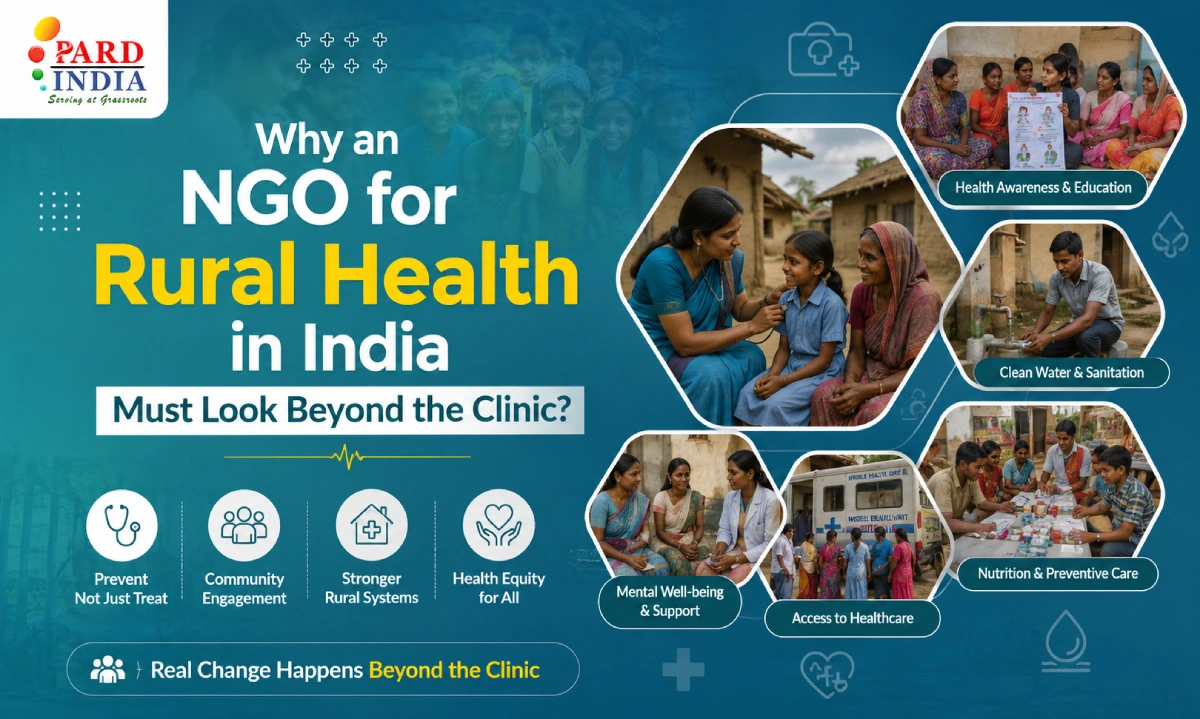
It is now time to adopt a whole new set of tactics if we really want to work on healing rather than just providing medical treatment to the people who are sick. The new strategy involves tackling the problems at the root and hence transforming a temporary medical intervention into a sustainable and community-based process of making people healthy. This blog tries to decode the shortcomings of the conventional clinic model while suggesting certain changes needed in order to tackle the issue holistically.
Why the Clinic-Only Model Is Failing?
In the event that a villager becomes sick, the first reaction is to turn towards medicines. However, when one becomes sick because of a lack of food and contamination in water, how effective will it be when they are prescribed treatment in a hospital and then go back to the same place? Medicines will not solve the problem of poverty or agricultural crisis, which are the root causes of sickness in rural areas. NGO for rural health in India need to think beyond the hospitals.
To understand why a paradigm shift is necessary, we must contrast the traditional approach with the holistic model:
| Clinic-Only Approach | Holistic Rural Approach |
|---|---|
| Focuses exclusively on reactive medical treatment only after a severe illness has struck the vulnerable rural community. | Focuses entirely on proactive, preventative care by deeply addressing the underlying environmental and social root causes of disease. |
| Treats severe malnutrition temporarily with synthetic nutritional supplements that do not last beyond the health camp. | Ensures long-term food security through sustainable agricultural support, empowering marginalized locals to grow their own nutrition. |
| Operates strictly within isolated medical silos, completely ignoring the daily local economic realities of the patients. | Integrates health, livelihood generation, and community sanitation into one cohesive, comprehensive development model for remote villages. |
| Provides temporary, short-term relief during sporadic health camps that vanish entirely once the external doctors leave. | Builds sustainable, community-driven health ecosystems that empower and upskill local residents to manage health all year round. |
| Depends heavily on continuous external medical professionals, expensive medical supplies, and unpredictable donor funding to function effectively. | Fosters local ownership by training village women and local farmers to become self-reliant grassroots health advocates themselves. |
New Approach: Integrating Food, Livelihood, and Health
However, in order to really turn the tables on the existing rulebook, one would need to create a connection between agricultural survival and physical well-being. This is something that organizations like PARD INDIA do successfully, slowly but surely, moving closer to bringing about positive change in people’s lives in the rural communities. The new rulebook includes five important components that connect food, livelihood, and health:
1. Nutritional Security as Preventive Medicine
There is no way to decouple these two components. With regular access to a variety of foods that provide the body with all the necessary nutrients, the immune system becomes much stronger, and the chances of getting sick significantly decrease.
2. Agricultural Empowerment as Healthcare
Education on the subject of sustainable agriculture will help farmers produce high yields. Healthy crops mean healthy village communities that can naturally withstand infections.
3. Livelihood Generation for Medical Access
The development of skills and the opening of small enterprises will help rural communities generate additional income. It will allow them to ensure good nutrition, create proper sanitation infrastructure, and receive medical help when needed.
4. Integration of Water and Sanitation
There can be no health without hygiene. Thus, by ensuring the provision of clean drinking water and sanitation, the new approach aims at eliminating transmission paths for deadly waterborne illnesses.
5. Community Ownership of Health
Sustainable health does not depend on external assistance. This approach implies educating local women, youth, and community leaders on hygiene and proper nutrition practices, which ensures the self-reliance of villages.
Wrapping It Up!
This truth is obvious: while clinics are crucial, alone they are insufficient for solving the problem of rural health crises. Therefore, NGO for rural health in India have to move beyond the medical field in order to start real healing. Thus, by switching the emphasis onto treatment of the whole village ecosystem, from food to hygiene, and improving people’s livelihoods. In order to bridge the gap between farms and clinics, it is necessary to address the reasons for the emergence of illnesses, not just their symptoms. In order to create a healthier, self-reliant India, it is important to apply such an approach.
As NGOs are doing their work supporting people by working in the field, we, as citizens and people of India, also need to contribute. To participate in the change, we can be a volunteer, donor, beneficiary, or support them to keep doing such work. Contact the PARD INDIA today and support their initiatives to improve rural life.
Frequently Asked Questions
Clinics mainly address symptoms without solving the problem. They rarely look into deeper problems, such as extreme malnutrition and poverty, without considering food security and sustainable income sources.
Food security is essential since it guarantees access to regular meals. Good nutrition is what builds up one’s immunity and prevents diseases. Nutrition is the primary mechanism that will ensure any medical treatment is successful.
Such programs empower farmers by equipping them with new technology and skills. They enable farmers to increase their farm produce, thus ensuring there is good nutrition in their households.
Women’s empowerment plays a role by contributing to the incomes that come into households, that increased verall income in the household. When they are financially empowered, they prioritize their family nutrition and health care needs, hence the impact on community health.
There are other methods used to ensure preventive health, such as the WASH program, nutrition programs, and school health programs, among others. They promote awareness in rural areas before the need for clinical intervention is required.