Challenges Faced by NGOs in India and How to Effectively Overcome Them
NGOs (non-governmental organizations) like PARD INDIA continue to address the phenomenon of Indian economic development by raising important issues that government schemes may not fully address, especially in rural areas. In addition, popular NGOs in India generally help bridge the gap between modern and rural communities by operating at a grassroots level in various places, including healthcare, gender equality, education, human rights, environmental issues, care for underprivileged children, and poverty alleviation campaigns. While we excel as grassroots NGOs, we also dedicate time to engaging with disadvantaged communities, providing support, and helping to crowdsource pathways for solutions that enhance the quality of life through sustainable practices.
Nonetheless, even with such necessary contributions, the top 10 NGO in India face severe challenges and obstacles that impede their effectiveness and sustainability. As previously mentioned, one of the main problems NGOs consistently run into is Financial instability. Because the vast majority of NGOs rely solely on donations and corporate social responsibility (CSR) funds, many NGOs face challenges due to inconsistent funding. Donations can and do fluctuate at any time, leaving an NGO with little to no notice or a local plan in place. Furthermore, in this extensive blog, we will discuss some specific issues NGOs in India face and ways to resolve these issues.
Why is Highlighting Challenges Crucial for NGOs?
Here, we have highlighted some of the key challenges that the best NGO websites in India face daily and how PARD INDIA is effectively overcoming these challenges.
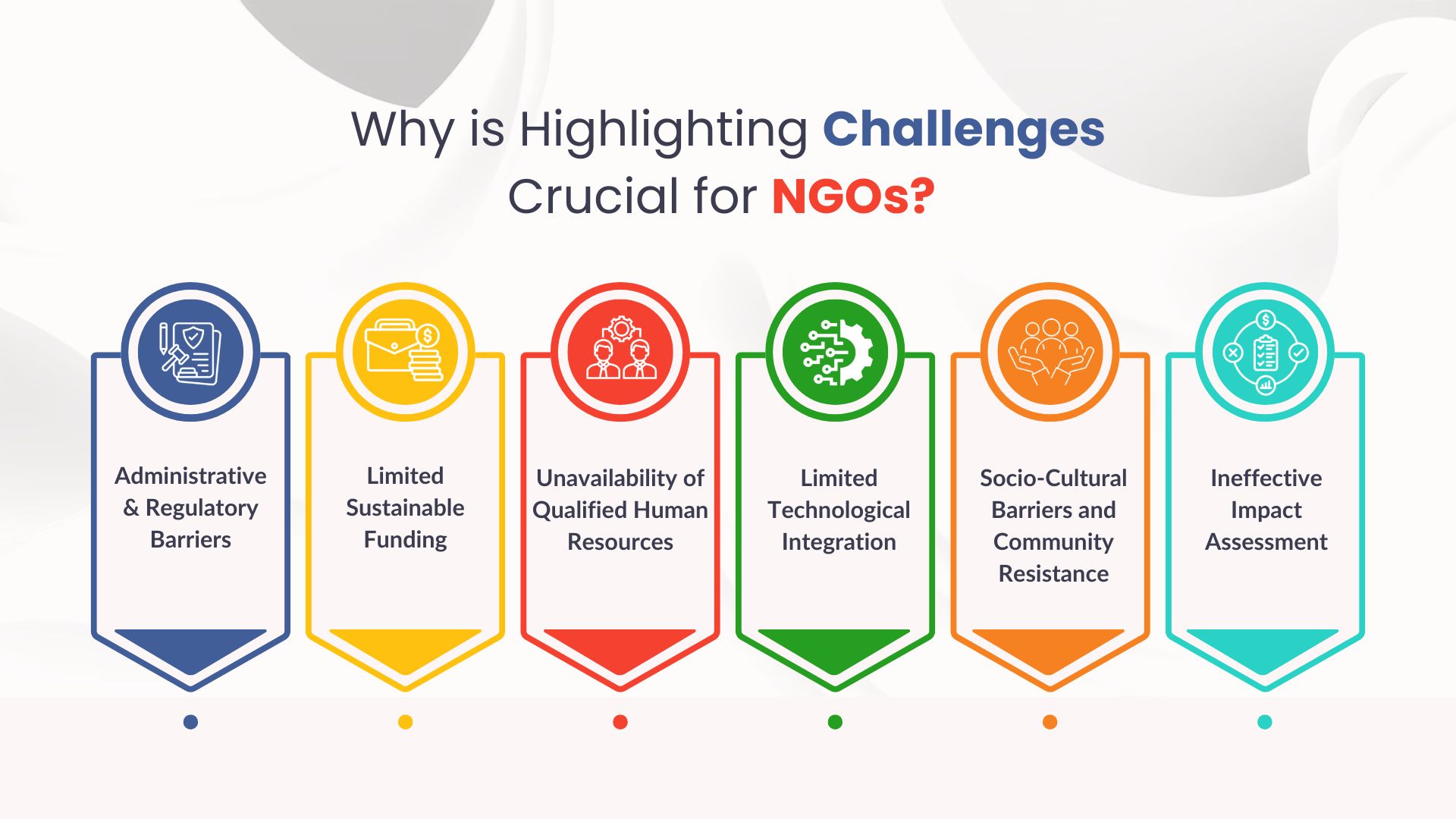
1. Administrative and Regulatory Barriers
One of the significant challenges NGOs in India face is the complex regulatory system and the time-consuming administrative process. Sticking to numerous pieces of legislation, such as the FCRA (Foreign Contribution Regulation Act) and the Income Tax Act, as well as obtaining registration with various government agencies, can prove discouraging.
How Can We Solve It?
NGOs must hire an internal team of experienced professionals who have precise knowledge and understanding of the complex regulatory landscape. Furthermore, it enhances transparency and reduces administrative resistance when all documents are updated, reports are filed before the deadline, and improves engagement with local authorities. Moreover, at PARD INDIA, one of the popular NGOs in India, we have already done all the above criteria to ensure our processes run seamlessly.
2. Limited Sustainable Funding
Numerous NGOs in India have to face a consistent struggle to manage their work due to limited and inconsistent funding. Furthermore, raising awareness among individuals to opt for donation under 80G is quite a challenging task, especially when most of the donation money goes to foreign-backed or short-term projects. Likewise, without constant support, it becomes difficult to strategize or run long-term programs.
How Can We Solve It?
One of the best solutions is that NGOs should seek support from multiple sources, including companies with Corporate Social Responsibility (CSR) initiatives, online crowdfunding platforms, and local donors. Therefore, building trust by showing impactful results and being open about finances can make a big difference. That is why, at PARD INDIA, a grassroots NGO in India, we promote transparency in our digital fundraising, involve local communities in planning, and align our projects with government missions, such as Viksit Bharat 2047, to attract government funding and corporate social responsibility (CSR) support.
3. Unavailability of Qualified Human Resources
Finding the right and skilled individual to collaborate with NGOs in rural areas is a challenging task. Thus, many professionals prefer private sector jobs that offer career growth and higher salaries. However, it makes it difficult for NGOs to build robust teams on the ground to build a bright place for underprivileged communities.
How Can We Solve It?
NGOs need to establish a sense of purpose and offer meaningful growth opportunities. Recognition, training leadership programs, and a positive work culture can attract passionate individuals who want to make a difference in the betterment of rural communities. PARD INDIA is setting an example through its READ Project, where we empower local young minds with skills, a strong sense of ownership, and leadership opportunities in the rural communities.
4. Limited Technological Integration
In today’s fast-paced digital age, technology can support NGOs in reaching a wider audience, functioning more efficiently, and tracking their impact. Nevertheless, numerous NGOs still lag, which makes it challenging to manage multiple programs or share their stories effectively.
How Can We Solve It?
Cost-effective digital tools are available easily. Hence, they should be used most prominently. NGOs can utilize these platforms to collect data, raise funds, spread awareness, and track progress. Moreover, at PARD INDIA, one of the best NGO websites in India, we utilize real-time digital dashboards to track our key projects and actively share inspiring stories on social media to build visibility and trust.
5. Socio-Cultural Barriers and Community Resistance
In several rural areas, deeply rooted beliefs, traditions, or myths can affect or even block positive change. Similarly, individuals might hesitate to accept new ideas, especially when it comes to raising issues like gender equality or the right to education.
How Can We Solve It?
Change happens when there is trust and unity. NGOs must respect local cultures, involve communities from the outset, and communicate effectively. On the other hand, awareness workshops, the support of respected community members, and regional advisory groups can also be helpful. At PARD INDIA, we maintain transparency with individuals about what we do, listening to them, walking alongside them, and learning to create real change.
6. Ineffective Impact Assessment
Several NGOs struggle to explain the effectiveness of their work. Thus, without accurate data, it is challenging to demonstrate results to donors or enhance programs. However, this lack of evidence can stop future growth and funding.
How Can We Solve It?
From the start, NGOs should plan how to measure their impact. Using practical tools to assess needs, evaluate success, and track progress makes it easier to show what is working and what is not. At PARD INDIA, we trust on real-time feedback, suggestions, and complex data to refine our work and make every minute and effort count.
7. Limited Inter-NGO Collaboration
Sometimes, NGOs work on the same issues, but their approaches do not align with each other. However, it is one of the most common issues that lead to missed opportunities, duplication, and less overall impact. Without the right partnerships, it is hard to innovate or scale.
How Can We Solve It?
Through partnerships and networks, NGOs can share ideas, create bigger change, and pool resources. PARD INDIA collaborates with government schools, hospitals, and other popular NGOs in India to implement a unified, multi-stakeholder approach to rural development.
8. Limited Access of Remote or Marginalized Communities
The most popular NGOs in India face logistical challenges in accessing remote or tribal areas, where assistance is most critical. Unforgiving terrain, the absence of transportation, language barriers, and suspicion by isolated communities render it very difficult to initiate or sustain social programs in such areas.
How Can We Solve It?
To counter this, NGOs must develop long-term engagement plans that involve enrolling local volunteers, training community leaders as facilitators, and establishing mobile outreach centers. Creating culturally sensitive communications in local languages and earning trust through sustained presence can also be beneficial. We have established a network of village representatives at PARD INDIA, the best NGO in India. We are utilizing mobile units to distribute educational materials, healthcare education, and food security programs, even in the most remote regions of Andhra Pradesh.
9. Lack of Media Visibility and Public Engagement
Although they do path-breaking work, numerous NGOs in India fail to receive proper media attention or online exposure. In the absence of a good communication strategy, their work goes unpicked, and the number of donations, volunteers, and admirers among influencers and game-changers decreases.
How Can We Solve It?
The top 10 NGO in India must invest in public relations, digital marketing, and storytelling. Frequent posts on social media, partnerships with content creators, and presentations of real-life impact stories can significantly expand their exposure. PARD INDIA regularly utilizes local media outlets, organizes community activities, and operates interactive social campaigns, enabling our mission to reach not only rural communities but also urban donors and CSR partners through emotional storytelling and a persistent online presence.
10. Volunteer Retention and Burnout
As much as volunteers are essential in the operations of NGOs, most organizations lack them for extended periods. Volunteers often disengage due to emotional burnout, a lack of appreciation, or an unclear work plan. As a result, they disengage, which hinders continuous programs and creates discontinuity.
How Can We Solve It?
To maintain long-term volunteers, NGOs should prioritize their welfare, offer mentorship, and provide recognition for their work. Developing an organized volunteer management system with assigned responsibilities, quarterly reviews, mental wellbeing support, and reward-based appreciation can significantly lower attrition. At PARD INDIA, one of the most popular NGOs in India, we recognize each volunteer’s efforts, provide regular training sessions, and foster a caring environment that promotes long-term volunteering through empathy and cause-led action.
11. Policy Uncertainty and Governmental Shifts
Straightforward modifications in government policy or administrative decisions, such as amendments to the FCRA (Foreign Contribution Regulation Act), tax exemptions, or guidelines for NGO operations, can jeopardize finances, hinder operations, or trigger legal issues. NGOs operating in multiple states are most susceptible to erratic bureaucratic decisions.
How Can We Solve It?
NGOs must stay informed about policy trends, ensure compliance, and establish advocacy wings that engage with policymakers. Partnerships with the best NGO in India and legal professionals also facilitate the interpretation and response to policy changes. At PARD INDIA, we actively track legal developments, keep in-house legal advisors, and align our activities with national development priorities to ensure continued operations and positive government relationships.
Turning Difficulties into Motivations for Building a Better Place!
Despite the numerous challenges we face in India, our primary role is to drive social development, empower underprivileged communities, and address pressing socio-economic problems that remain unresolved. NGOs function as catalysts for change, working relentlessly in rural areas to address issues such as poverty alleviation, human rights, environmental protection, and healthcare. Nevertheless, to continue and expand this impactful work, PARD INDIA takes effective ways to overcome the obstacles that hamper our progress.
Additionally, while social transformation is a complex process, PARD INDIA demonstrates that it can be achieved through adaptive strategies, a clear purpose, and strong community engagement. Likewise, these challenges can be transformed into bright opportunities. The mission to establish an equitable society demands resilience, collaboration, and innovation.
At PARD INDIA, a grassroots NGO in India, every hurdle becomes a learning opportunity, and every restriction sparks a new solution. As we continue to empower rural communities through education, awareness, and development, we invite donors, partners, and individuals to join us in overcoming these challenges and building a stronger, more inclusive India.