
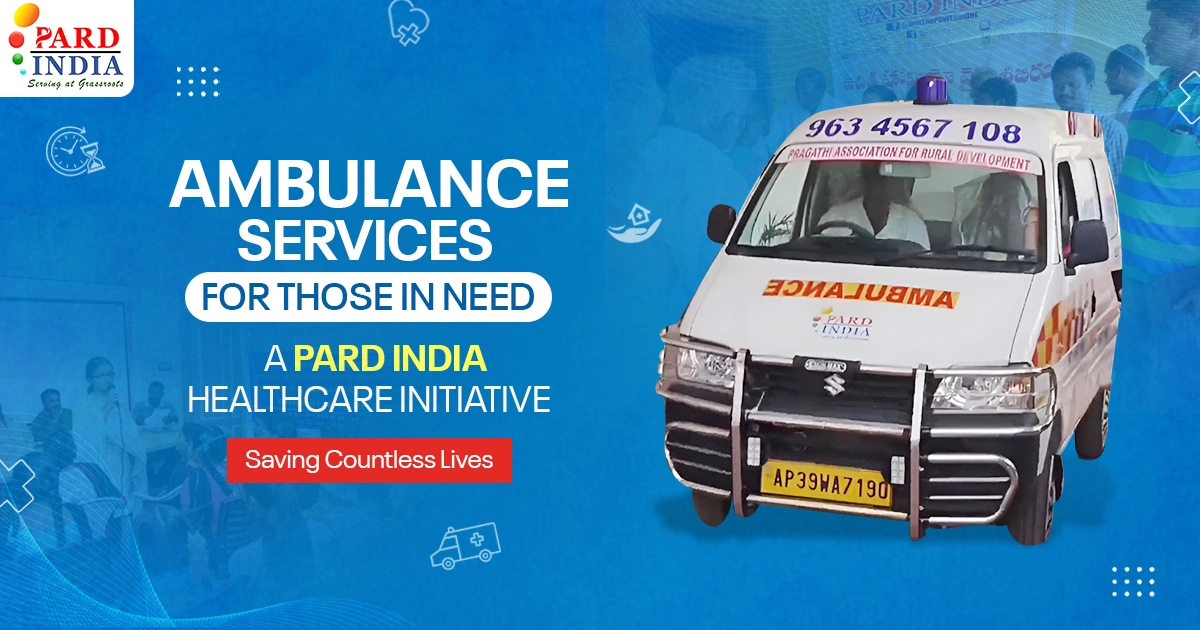
Saving Lives in Time: The Impact of PARD INDIA’s Ambulance Services
In the quiet, starlit stretches of rural India, the silence of the night is often a source of peace. But for a family facing a medical crisis, that same silence can be terrifying. In these remote pockets, the difference between life and death isn’t just medical expertise it is time. When a heart stops, when a labor complication arises, or when an accident occurs on a lonely highway, every second is a heartbeat closer to either a miracle or a tragedy.
At PARD INDIA (Pragathi Association for Rural Development), we have spent years walking the dusty paths of these villages. We have seen firsthand that geography should never be a death sentence. Our ambulance initiative is not merely a transport service; it is a mobile sanctuary, a rolling lifeline, and a bridge of hope for the marginalized who have been left behind by urban progress.
Why PARD INDIA Stepped into Healthcare
Since our inception in 2011, PARD INDIA has been a champion for the “last mile” citizen. Our primary mission began with education and environmental sustainability, building the pillars of a better tomorrow for rural children. However, a sobering reality soon became apparent: You cannot educate a child or empower a community if their basic right to survival is compromised by a lack of emergency care.
We realized that many of the children in our programs were losing parents or grandparents to treatable conditions simply because they couldn’t reach a hospital in time. We saw families fall into a cycle of “medical poverty,” selling their meager land or livestock to pay for an exorbitant private vehicle during a midnight emergency. This urgent necessity gave birth to the PARD INDIA Ambulance Service. We didn’t just want to provide a ride; we wanted to provide a professional, dignified, and rapid medical response system.
Understanding the “Golden Hour” Crisis
In emergency medicine, there is a concept known as the “Golden Hour.” This refers to the critical sixty-minute window following a traumatic injury or a sudden medical event (like a stroke or cardiac arrest). If a patient receives definitive care within this hour, their chances of survival and full recovery increase exponentially.
Rural Reality vs. The Golden Hour
In metropolitan cities, while traffic is a hurdle, the density of hospitals is high. In rural India, the hurdles are systemic:
- The Vanishing Transport: After 8:00 PM, public transport in many mandals virtually disappears. Expecting a rickshaw or a bus to appear during a midnight crisis is often a futile hope.
- Predatory Pricing: Private vehicle owners often exploit the desperation of poor families, charging three to five times the standard rate for an emergency trip to the city.
- The Terrain Challenge: Many villages are located across unpaved roads, seasonal streams, or rough terrain. Standard consumer vehicles are not built to transport a patient safely over these bumps, often worsening spinal injuries or causing further distress to the patient.
The PARD INDIA Ambulance Model: More Than a Vehicle
Our initiative is built on three core pillars: Equipment, Expertise, and Empathy. We don’t just offer a van; we offer a mobile medical unit.
A. Equipped for Critical Care
Every PARD INDIA ambulance is a mini-ER on wheels. We ensure our vehicles are fitted with:
High-Flow Oxygen Cylinders: Vital for respiratory distress, which is common in rural areas due to pesticide exposure or underlying conditions.
Advanced First Aid & Trauma Kits: To stabilize fractures and stop bleeding on site.
Nebulizers and Suction Machines: Critical for pediatric emergencies and elderly patients.
B. Trained Personnel
A machine is only as good as the person operating it. Our drivers are more than just chauffeurs; they are trained in basic life support and navigate the treacherous rural roads with a sense of mission. They are supported by a network of PARD INDIA volunteers who act as “First Responders,” coordinating with the hospital while the ambulance is en route so the doctors are ready the moment the doors open.
C. The Principle of Affordability
Financial status should never dictate who lives and who dies. PARD INDIA ensures that our services are accessible to the most deprived sections of society. By subsidizing or providing free services to the poorest families, we remove the “fear of cost” that often causes families to delay seeking help until it is too late.
Voices from the Field: Real-Life Impact Stories
Numbers and statistics tell a story, but human lives define it. Two recent interventions highlight the vital role our service plays in the West Godavari and surrounding regions.
Case Study 1: Saving a Limb, Saving a Livelihood
Mr. Mullapudi Mangaraju, a hardworking resident of Pullalapadu village in Nallajerla Mandal, found himself in a dire situation. What started as a minor injury escalated into a severe, life-threatening leg infection. For a rural laborer, the loss of a limb is the loss of a livelihood.
When his condition became critical, his family was paralyzed by the logistics of moving him to a specialized facility. They reached out to the PARD INDIA Ambulance Service. Our team responded immediately. We transported Mr. Mangaraju from the remote Pullalapadu to Sun Rise Hospital in Rajahmundry. Because of the rapid transport, doctors were able to intervene before the infection turned systemic (sepsis). Today, the family credits PARD INDIA for keeping their breadwinner on his feet.
Case Study 2: The Breath of Life
In Yernagudem village, Devarapalli Mandal, Mr. Rudrapaka Sriramamurthy was battling a severe respiratory crisis. His lungs were failing, and every breath was a struggle. In cases of respiratory failure, minutes matter. Oxygen deprivation can lead to permanent organ damage or death within a very short window.
The call came into the PARD INDIA dispatch, and our ambulance arrived with life-saving oxygen support. He was stabilized during the transit from Yernagudem to Smart Hospital in Rajahmundry. His family’s heartfelt gratitude serves as a reminder that we aren’t just moving bodies; we are moving fathers, grandfathers, and friends.
The Multiplier Effect: How This Service Changes Communities
The impact of a reliable ambulance service ripples through the entire social fabric of a village.
- Maternal and Neonatal Safety: One of our biggest successes is facilitating institutional deliveries. By providing a safe way for pregnant women in labor to reach the hospital, we are directly contributing to a reduction in maternal and infant mortality rates.
- Empowerment through Security: When a community knows there is an ambulance available, their psychological well-being improves. Farmers and laborers are more likely to seek early treatment for minor ailments before they become emergencies, knowing they have a safety net.
- Strengthening Local Healthcare: We act as the vital link between the Primary Health Centers (PHCs) and specialized Tertiary Hospitals. We ensure the “referral system” works by providing the physical means to move patients up the chain of care.
Navigating the Storm: Our Daily Challenges
Running a 24/7 emergency service in rural India is an uphill battle. It requires more than just passion; it requires immense resilience.
- The Logistics of Maintenance: Driving on unpaved, pothole-ridden roads takes a heavy toll on our vehicles. Frequent tire changes, suspension repairs, and engine servicing are mandatory to ensure the ambulance doesn’t break down when a life is on the line.
- The Digital Divide: In “dark zones” where mobile signals are weak, families often must run to higher ground just to make a call to us. We are constantly working on ways to improve our communication network.
- The Rising Cost of Fuel: With fluctuating fuel prices, the cost of a single 100km round trip to a city hospital can be significant. Sustaining this without passing on the burden to the poor is a constant financial tightrope walk.
A Vision for the Future: Scaling Hope
We aren’t stopping here. PARD INDIA has a roadmap to revolutionize rural emergency care:
- Motorcycle Ambulances: For villages with extremely narrow lanes or those separated by forests, we aim to introduce “First Responder Bikes” equipped with basic medical kits and oxygen.
- Digital Integration: We are exploring GPS tracking and a centralized mobile app to allow villagers to “one-tap” for help, like urban ride-hailing services but for life-saving care.
- Fleet Expansion: Our goal is a “Mandal-based Fleet,” where no village is more than 20 minutes away from a PARD INDIA ambulance.
Become a Partner in This Mission
This initiative survives in the spirit of “The Power of One”. You don’t need to be a doctor to save a life; you just need to help us keep the wheels turning.
- For Corporations: Through CSR (Corporate Social Responsibility) initiatives, your organization can sponsor a new ambulance. We proudly display our partners’ logos on our vehicles, showing the community who stands with them.
- For Individuals: A small monthly donation can cover the fuel for five emergency trips. Your “coffee money” could be the reason a mother makes it to the hospital on time.
- For the Youth: Join us as a volunteer. Help us spread awareness about the service in your local village and act as a coordinator during emergencies.
Promise of Hope
An ambulance is more than a vehicle with a siren. To the person gasping for breath, it is a promise that help is coming. To the family in panic, it is the arrival of a professional hand to hold. To PARD INDIA, it is the ultimate expression of our commitment to rural development.
We invite you to join us. Together, we can ensure that “Saving Lives in Time” is a reality for every citizen, regardless of where they live or how much they earn.
Help us keep the wheels moving. Your support can provide the next “Golden Hour” miracle.
Sponsoring an Ambulance